AEM vs Contentful: Which CMS Actually Fits Your Business
Adobe Experience Manager and Contentful sit at opposite ends of the CMS spectrum. We've built on both. Here's an honest breakdown of what each is genuinely good at — and who's paying for capability they'll never use.
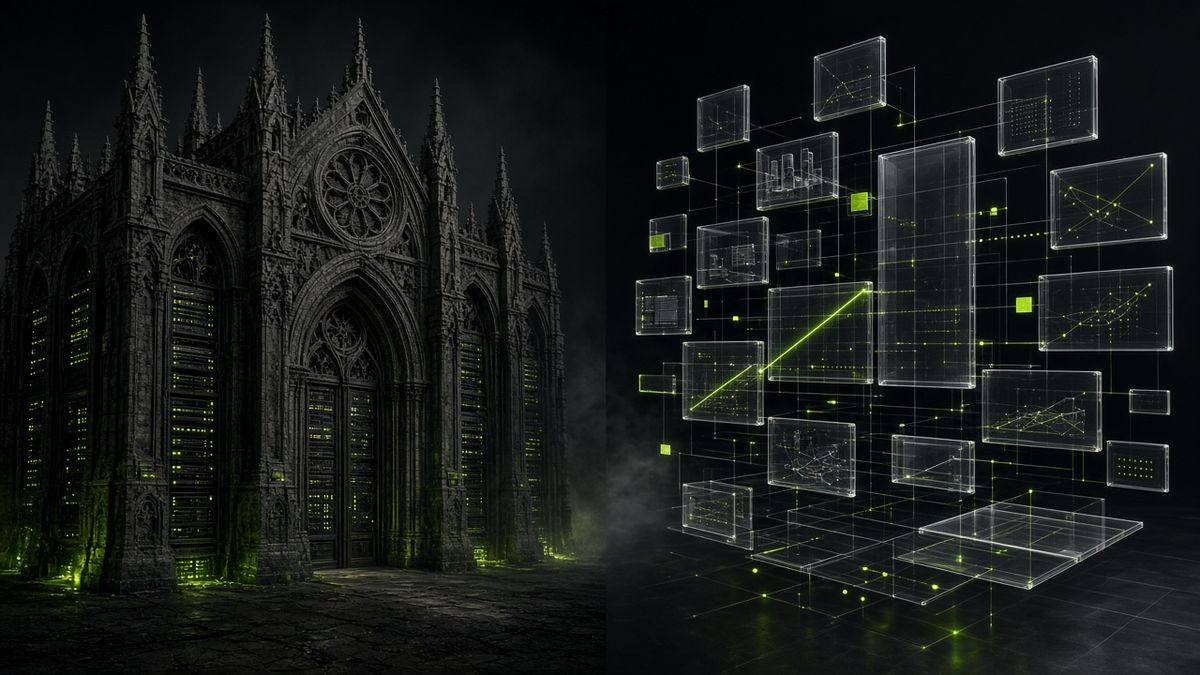
AEM and Contentful get compared constantly, usually by teams trying to justify a decision they've already made. The comparison is awkward because they're not really the same kind of product. One is a sprawling enterprise suite that does everything. The other is a focused content API that does one thing and expects you to bring the rest.
We've built and maintained sites on both. This isn't a feature-matrix comparison — you can find those on vendor sites, and they're written to sell. This is the honest version: what each is actually good at, where each hurts, and how to tell which one your business genuinely needs versus which one a salesperson wants you to need.
They're solving different problems
Adobe Experience Manager is a traditional (coupled) enterprise CMS. It manages content and renders the pages, bundles a serious digital asset management system, and plugs directly into the rest of Adobe's marketing stack — Analytics, Target, Campaign. It's Java underneath (Apache Sling, a JCR content repository, OSGi bundles), it's heavyweight, and it's built for large organisations with complex governance, many authors, many sites, and many languages.
Contentful is a headless, API-first CMS. It stores structured content and hands it to you as JSON over REST or GraphQL. It has no opinion about how your site looks or what framework you use — you build the frontend, Contentful feeds it content. It's a SaaS product, so there's no infrastructure to run, and it's designed to feed content to many channels at once: a website, a mobile app, a kiosk, a smartwatch.
That difference — 'does everything including the page' versus 'does content, you do the rest' — drives every other trade-off below.
What AEM is genuinely good at
AEM earns its reputation in a specific set of conditions, and if you're in them, nothing else quite matches it.
Governance at scale. If you have hundreds of authors across dozens of business units, all needing controlled workflows, approval chains, and role-based permissions, AEM's authoring model was built for exactly this. Content teams work in a visual, component-based editor with real guardrails.
Multi-site and multi-language. AEM's multi-site manager and translation workflows handle 40 regional sites in 20 languages without falling apart. For a global brand keeping content consistent across markets, this is the core value.
Assets. The built-in DAM is enterprise-grade — versioning, metadata, renditions, rights management. If managing tens of thousands of images and videos is a first-class problem for you, AEM treats it as one.
Deep Adobe integration. If you already run Adobe Analytics, Target, and Campaign, AEM is the piece that makes personalisation and experimentation feel native rather than bolted on.
What AEM actually costs — and we don't just mean licensing
AEM licensing starts in the low-to-mid six figures per year and climbs from there. That's the number people quote. It's not the number that hurts.
The real cost is everything around it. AEM needs specialised developers, and they're rare and expensive — the pool of people who genuinely know Sling, the dispatcher, and AEM's quirks is small, especially in Australia. Implementations routinely run six figures again on top of licensing and take months. Ongoing maintenance is not something a generalist web team can pick up. Even Adobe's newer Cloud Service offering (AEMaaCS), which removes the on-prem infrastructure burden, doesn't remove the specialist-knowledge burden.
We've been called in to audit AEM builds where the client was paying enterprise money to publish what was, functionally, a brochure site with a blog. The platform was capable of far more than they'd ever use. That's the most common AEM failure mode we see: not that it doesn't work, but that it's radically over-specified for the actual job.
What Contentful is good at
Contentful wins on speed, flexibility, and developer experience.
Fast to start. You can model your content types and be serving content through an API in an afternoon. There's no infrastructure to provision, no repository to configure, no dispatcher to tune.
Frontend freedom. Because it's headless, you build with whatever you want — Next.js, Astro, a native app, all three off the same content. For omnichannel businesses this is the whole point: write once, deliver everywhere.
Developer-friendly. The APIs are clean, the docs are good, and the mental model is simple: content in, JSON out. A competent Next.js developer is productive on Contentful immediately — no specialist certification required.
It scales operationally. As SaaS, it grows with you without you managing servers, patching, or planning capacity.
For most modern web builds — a marketing site, a content-heavy product site, a JAMstack storefront — Contentful or something like it is the sensible default in 2026.
Where Contentful bites you
Headless is not free of trade-offs, and the honest failures are worth knowing before you commit.
You build everything the CMS used to give you. Preview, the editing experience, page composition, personalisation — none of it comes for free. Contentful gives content teams a structured-fields editor, not a visual page builder. Authors who expect to drag components around a live preview find it less intuitive than a coupled CMS, and closing that gap is engineering work you now own.
Pricing scales in ways that surprise people. The entry tiers look cheap. Then you add spaces, environments, seats, roles, and API call volume, and the bill climbs. At high traffic or large teams, Contentful is not the bargain the starting price suggests — model your real usage before you commit.
Governance is thinner. Workflows, granular permissions, and approval chains exist but are nowhere near AEM's depth. If controlled multi-team publishing is your core problem, you'll be building around Contentful's limits.
No serious built-in DAM. Asset handling is basic. Heavy asset workflows mean bolting on a dedicated DAM.
How we actually decide
We don't have a house favourite — we have a set of questions that usually make the answer obvious.
Are you already deep in the Adobe ecosystem, with the budget and the governance needs to match? If you're running Analytics, Target, and Campaign, have hundreds of authors, and manage dozens of sites across markets — AEM is doing a job Contentful genuinely can't. Buy the capability you'll use.
Are you a modern digital business that wants a fast, flexible site and delivery across channels? Contentful (or a comparable headless CMS) will get you there faster, cheaper, and with a hiring pool that isn't a bottleneck.
Somewhere in between? That's most businesses, and it's where the honest answer is usually 'neither of these two specifically'. The headless market is crowded — Sanity, Strapi, Payload, and others each win on different axes. Contentful is the reference point, not the only option.
The deciding factor is almost never the feature list. It's whether you have the team, budget, and genuine complexity to justify AEM's weight. If you have to ask whether you need AEM, you probably don't.
The honest takeaway
AEM is a Formula 1 car. In the right race, with the right crew and budget, nothing beats it. Driven to the shops for milk, it's an expensive, impractical mistake — and a lot of businesses are driving it to the shops.
Contentful is a well-engineered everyday vehicle. It'll do almost everything most businesses need, it's cheap to run by comparison, and any competent developer can maintain it. Its limits are real but predictable.
Pick the platform that matches the problem you actually have, not the one that matches the business you'd like to look like. If you're weighing the two and want a straight answer for your specific situation — not a sales pitch — that's exactly the kind of thing our free assessment is for.
Ready to apply this to your business?